Art That Represents Chinese Culture During Second Sino War
| Chinese martial arts | |||||||||||||||||
|---|---|---|---|---|---|---|---|---|---|---|---|---|---|---|---|---|---|
| Traditional Chinese | 武術 | ||||||||||||||||
| Simplified Chinese | 武术 | ||||||||||||||||
| Literal significant | "martial technique" | ||||||||||||||||
| |||||||||||||||||
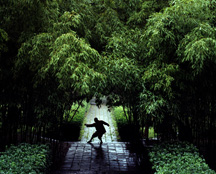
A monk practicing kung fu in the bamboo forest inside the Shaolin Temple
Chinese martial arts, frequently chosen by the umbrella terms kung fu (; Chinese: 功夫; pinyin: gōngfu ; Cantonese Yale: gūng fū ), kuoshu (國術; guóshù ) or wushu (武術; wǔshù ), are multiple fighting styles that take adult over the centuries in Greater China. These fighting styles are often classified co-ordinate to common traits, identified as "families" of martial arts. Examples of such traits include Shaolinquan (少林拳) physical exercises involving All Other Animals (五形) mimicry or grooming methods inspired by One-time Chinese philosophies, religions and legends. Styles that focus on qi manipulation are chosen internal ( 内家拳 ; nèijiāquán ), while others that concentrate on improving muscle and cardiovascular fettle are called external ( 外家拳 ; wàijiāquán ). Geographical clan, every bit in northern ( 北拳 ; běiquán ) and southern ( 南拳 ; nánquán ), is another popular classification method.
Terminology [edit]
Kung fu, wushu and "Cultivation" are loanwords from Cantonese and Mandarin respectively that, in English, are used to refer to Chinese martial arts. Still, the Chinese terms kung fu and wushu (  listen (Standard mandarin)(help·info) ; Cantonese Yale: móuh seuht ) have singled-out meanings.[1] The Chinese equivalent of the term "Chinese martial arts" would exist Zhongguo wushu (Chinese: 中國武術; pinyin: zhōngguó wǔshù ) (Standard mandarin).
In Chinese, the term kung fu refers to any skill that is acquired through learning or practise. It is a compound word equanimous of the words 功 (gōng) meaning "work", "achievement", or "merit", and 夫 (fū) which is a particle or nominal suffix with various meanings.
Wushu literally means "martial art". It is formed from the two Chinese characters 武術 : 武 ( wǔ ), meaning "martial" or "war machine" and 術 or 术 ( shù ), which translates into "art", "subject area", "skill" or "method". The term wushu has also get the proper noun for the modern sport of wushu, an exhibition and full-contact sport of bare-handed and weapon forms (套路), adjusted and judged to a set of aesthetic criteria for points developed since 1949 in the People'due south Commonwealth of China.[2] [3]
Quánfǎ ( 拳法 ) is some other Chinese term for Chinese martial arts. It means "fist method" or "the law of the fist" (quán ways "boxing" or "fist", and fǎ means "constabulary", "way" or "method"), although as a compound term it usually translates as "boxing" or "fighting technique." The name of the Japanese martial art kempō is represented by the same hanzi characters.
History [edit]
The genesis of Chinese martial arts has been attributed to the need for self-defense, hunting techniques and military training in ancient China. Paw-to-hand combat and weapons practice were important in training aboriginal Chinese soldiers.[4] [5]
Detailed noesis nigh the state and evolution of Chinese martial arts became bachelor from the Nanjing decade (1928–1937), as the Key Guoshu Establish established by the Kuomintang regime made an effort to compile an encyclopedic survey of martial arts schools. Since the 1950s, the People'due south Democracy of China has organized Chinese martial arts equally an exhibition and full-contact sport under the heading of "wushu".
Legendary origins [edit]
According to legend, Chinese martial arts originated during the semi-mythical Xia Dynasty (夏朝) more than four,000 years ago.[vi] It is said the Yellowish Emperor (Huangdi) (legendary appointment of ascension 2698 BCE) introduced the earliest fighting systems to China.[7] The Yellow Emperor is described as a famous general who, earlier becoming China's leader, wrote lengthy treatises on medicine, astrology and the martial arts. I of his main opponents was Chi You (蚩尤) who was credited equally the creator of jiao di, a forerunner to the modern art of Chinese wrestling.[8]
Early on history [edit]
The primeval references to Chinese martial arts are found in the Jump and Autumn Annals (5th century BCE),[ix] where a hand-to-manus combat theory, ane that integrates notions of "difficult" and "soft" techniques, is mentioned.[x] A combat wrestling organization called juélì or jiǎolì ( 角力 ) is mentioned in the Classic of Rites.[xi] This combat system included techniques such every bit strikes, throws, joint manipulation, and pressure point attacks. Jiao Di became a sport during the Qin Dynasty (221–207 BCE). The Han History Bibliographies record that, by the Quondam Han (206 BCE – 8 CE), there was a distinction between no-holds-barred weaponless fighting, which it calls shǒubó ( 手搏 ), for which training manuals had already been written, and sportive wrestling, then known equally juélì ( 角力 ). Wrestling is likewise documented in the Shǐ Jì, Records of the Grand Historian, written by Sima Qian (ca. 100 BCE).[12]
In the Tang Dynasty, descriptions of sword dances were immortalized in poems past Li Bai. In the Song and Yuan dynasties, xiangpu contests were sponsored by the imperial courts. The modernistic concepts of wushu were fully adult by the Ming and Qing dynasties.[thirteen]
Philosophical influences [edit]
The ideas associated with Chinese martial arts changed with the evolution of Chinese society and over time caused some philosophical bases: Passages in the Zhuangzi ( 莊子 ), a Taoist text, pertain to the psychology and practice of martial arts. Zhuang Zi, its eponymous writer, is believed to have lived in the quaternary century BCE. The Tao Te Ching, frequently credited to Lao Zi, is some other Taoist text that contains principles applicative to martial arts. According to one of the archetype texts of Confucianism, Zhou Li ( 周禮 ), Archery and charioteering were office of the "six arts" (Chinese: 六藝; pinyin: liu yi , including rites, music, calligraphy and mathematics) of the Zhou Dynasty (1122–256 BCE). The Art of War ( 孫子兵法 ), written during the sixth century BCE by Sun Tzu ( 孫子 ), deals straight with war machine warfare but contains ideas that are used in the Chinese martial arts.
Taoist practitioners have been practicing Tao Yin (physical exercises like to Qigong that was i of the progenitors to T'ai chi ch'uan) from as early as 500 BCE.[14] In 39–92 CE, "Vi Chapters of Hand Fighting", were included in the Han Shu (history of the Sometime Han Dynasty) written by Pan Ku. Also, the noted physician, Hua Tuo, composed the "Five Animals Play"—tiger, deer, monkey, behave, and bird, effectually 208 CE.[xv] Taoist philosophy and their approach to health and do have influenced the Chinese martial arts to a sure extent. Direct reference to Taoist concepts can be found in such styles as the "Eight Immortals," which uses fighting techniques attributed to the characteristics of each immortal.[16]
Southern and Northern dynasties (420–589 Advertizement) [edit]
Shaolin temple established [edit]
In 495 CE, a Shaolin temple was congenital in the Song mountain, Henan province. The first monk who preached Buddhism there was the Indian monk named Buddhabhadra (佛陀跋陀羅; Fótuóbátuóluó ), simply chosen Batuo (跋陀) by the Chinese. In that location are historical records that Batuo's outset Chinese disciples, Huiguang (慧光) and Sengchou (僧稠), both had infrequent martial skills.[ citation needed ] For example, Sengchou'due south skill with the tin staff is even documented in the Chinese Buddhist canon.[ citation needed ] After Buddhabadra, another Indian[17] monk, named Bodhidharma (菩提達摩; Pútídámó ), too known as Damo (達摩) by the Chinese, came to Shaolin in 527 CE. His Chinese disciple, Huike (慧可), was also a highly trained martial arts practiced.[ citation needed ] There are implications that these first three Chinese Shaolin monks, Huiguang, Sengchou, and Huike, may have been military men earlier inbound the monastic life.[xviii]
Shaolin and temple-based martial arts [edit]
The Shaolin style of kung fu is regarded as 1 of the first institutionalized Chinese martial arts.[19] The oldest testify of Shaolin participation in combat is a stele from 728 CE that attests to two occasions: a defense of the Shaolin Monastery from bandits around 610 CE, and their subsequent role in the defeat of Wang Shichong at the Battle of Hulao in 621 CE. From the 8th to the 15th centuries, there are no extant documents that provide show of Shaolin participation in gainsay.
Between the 16th and 17th centuries, at least forty sources exist to provide show both that monks of Shaolin practiced martial arts, and that martial practice became an integral chemical element of Shaolin monastic life. The earliest appearance of the oftentimes cited legend concerning Bodhidharma's supposed foundation of Shaolin Kung Fu dates to this period.[xx] The origin of this legend has been traced to the Ming menstruum's Yijin Jing or "Musculus Change Classic", a text written in 1624 attributed to Bodhidharma.

Depiction of fighting monks demonstrating their skills to visiting dignitaries (early 19th-century mural in the Shaolin Monastery).
References of martial arts practice in Shaolin appear in diverse literary genres of the late Ming: the epitaphs of Shaolin warrior monks, martial-arts manuals, military machine encyclopedias, historical writings, travelogues, fiction, and poesy. Notwithstanding, these sources do not point out any specific style that originated in Shaolin.[21] These sources, in dissimilarity to those from the Tang period, refer to Shaolin methods of armed combat. These include a skill for which Shaolin monks became famous: the staff (gùn, Cantonese gwan). The Ming Full general Qi Jiguang included a clarification of Shaolin Quan Fa (Chinese: 少林拳法; Wade–Giles: Shao Lin Ch'üan Fa ; lit. 'Shaolin fist technique'; Japanese: Shorin Kempo) and staff techniques in his volume, Ji Xiao Xin Shu ( 紀效新書 ), which can interpret as New Book Recording Effective Techniques. When this book spread across East asia, information technology had a corking influence on the development of martial arts in regions such as Okinawa[22] and Korea.[23]
Modern history [edit]
Republican menstruation [edit]
Most fighting styles that are existence practiced as traditional Chinese martial arts today reached their popularity within the 20th century. Some of these include Baguazhang, Drunken Battle, Eagle Claw, Five Animals, Xingyi, Hung Gar, Monkey, Bak Mei Pai, Northern Praying Mantis, Southern Praying Mantis, Fujian White Crane, Jow Ga, Wing Chun and Taijiquan. The increase in the popularity of those styles is a result of the dramatic changes occurring inside the Chinese order.
In 1900–01, the Righteous and Harmonious Fists rose against strange occupiers and Christian missionaries in Mainland china. This uprising is known in the West as the Boxer Rebellion due to the martial arts and calisthenics practiced past the rebels. Empress Dowager Cixi gained control of the rebellion and tried to use information technology against the foreign powers. The failure of the rebellion led ten years later to the fall of the Qing Dynasty and the creation of the Chinese Republic.
The present view of Chinese martial arts is strongly influenced by the events of the Republican Menses (1912–1949). In the transition menstruation betwixt the autumn of the Qing Dynasty every bit well as the turmoil of the Japanese invasion and the Chinese Civil State of war, Chinese martial arts became more accessible to the general public as many martial artists were encouraged to openly teach their art. At that time, some considered martial arts every bit a means to promote national pride and build a strong nation. As a event, many training manuals (拳譜) were published, a training academy was created, two national examinations were organized and sit-in teams traveled overseas.[24] Numerous martial arts associations were formed throughout China and in various overseas Chinese communities. The Central Guoshu Academy (Zhongyang Guoshuguan, 中央國術館) established by the National Authorities in 1928[25] and the Jing Wu Athletic Association (精武體育會) founded by Huo Yuanjia in 1910 are examples of organizations that promoted a systematic arroyo for grooming in Chinese martial arts.[26] [27] [28] A series of provincial and national competitions were organized by the Republican regime starting in 1932 to promote Chinese martial arts. In 1936, at the 11th Olympic Games in Berlin, a group of Chinese martial artists demonstrated their art to an international audience for the offset time.
The term kuoshu (or guoshu, 國術 meaning "national fine art"), rather than the colloquial term gongfu was introduced by the Kuomintang in an try to more closely associate Chinese martial arts with national pride rather than individual achievement.
People'south Republic [edit]
Chinese martial arts experienced rapid international dissemination with the cease of the Chinese Civil War and the founding of the People's Republic of China on October 1, 1949. Many well known martial artists chose to escape from the Red china'south rule and drift to Taiwan, Hong Kong,[29] and other parts of the world. Those masters started to teach within the overseas Chinese communities but somewhen they expanded their teachings to include people from other ethnic groups.
Inside China, the practice of traditional martial arts was discouraged during the turbulent years of the Chinese Cultural Revolution (1969–1976).[3] Like many other aspects of traditional Chinese life, martial arts were subjected to a radical transformation by the People's Republic of Communist china to align them with Maoist revolutionary doctrine.[iii] The PRC promoted the commission-regulated sport of Wushu as a replacement for independent schools of martial arts. This new competition sport was disassociated from what was seen as the potentially subversive self-defense aspects and family lineages of Chinese martial arts.[three]
In 1958, the government established the All-Mainland china Wushu Association every bit an umbrella organization to regulate martial arts preparation. The Chinese State Commission for Physical Culture and Sports took the lead in creating standardized forms for about of the major arts. During this menses, a national Wushu system that included standard forms, teaching curriculum, and instructor grading was established. Wushu was introduced at both the loftier schoolhouse and university level. The suppression of traditional teaching was relaxed during the Era of Reconstruction (1976–1989), equally Communist ideology became more accommodating to alternative viewpoints.[30] In 1979, the Country Commission for Physical Civilization and Sports created a special task strength to reevaluate the educational activity and exercise of Wushu. In 1986, the Chinese National Research Institute of Wushu was established as the fundamental potency for the inquiry and administration of Wushu activities in the People's republic of china.[31]
Changing government policies and attitudes towards sports, in general, led to the closing of the State Sports Commission (the central sports authority) in 1998. This closure is viewed as an attempt to partially de-politicize organized sports and move Chinese sport policies towards a more market-driven arroyo.[32] As a result of these changing sociological factors inside Red china, both traditional styles and mod Wushu approaches are beingness promoted by the Chinese government.[33]
Chinese martial arts are an integral element of 20th-century Chinese pop culture.[34] Wuxia or "martial arts fiction" is a popular genre that emerged in the early 20th century and peaked in popularity during the 1960s to 1980s. Wuxia films were produced from the 1920s. The Kuomintang suppressed wuxia, accusing it of promoting superstition and violent anarchy. Because of this, wuxia came to flourish in British Hong Kong, and the genre of kung fu flick in Hong Kong action cinema became wildly pop, coming to international attention from the 1970s. The genre underwent a drastic refuse in the late 1990s as the Hong Kong moving-picture show manufacture was crushed by economic depression.
In the wake of Ang Lee's Crouching Tiger, Hidden Dragon (2000), there has been somewhat of a revival of Chinese-produced wuxia films aimed at an international audience, including Zhang Yimou'due south Hero (2002), House of Flying Daggers (2004) and Curse of the Golden Flower (2006), likewise every bit Su Chao-pin and John Woo's Reign of Assassins (2010).
Styles [edit]
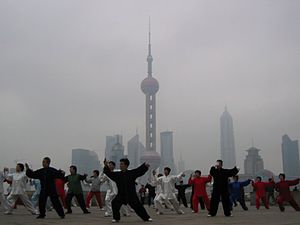
China has a long history of martial arts traditions that includes hundreds of different styles. Over the past two k years, many distinctive styles have been adult, each with its own fix of techniques and ideas.[35] At that place are also common themes to the unlike styles, which are oftentimes classified past "families" ( 家 ; jiā ), "sects" ( 派 ; pai ) or "schools" ( 門 ; men ). At that place are styles that mimic movements from animals and others that gather inspiration from various Chinese philosophies, myths and legends. Some styles put most of their focus into the harnessing of qi, while others concentrate on contest.
Chinese martial arts can be split into diverse categories to differentiate them: For case, external ( 外家拳 ) and internal ( 內家拳 ).[36] Chinese martial arts tin can besides be categorized by location, as in northern ( 北拳 ) and southern ( 南拳 ) equally well, referring to what part of Communist china the styles originated from, separated by the Yangtze River (長江); Chinese martial arts may even exist classified co-ordinate to their province or city.[24] The main perceived difference between northern and southern styles is that the northern styles tend to emphasize fast and powerful kicks, high jumps and more often than not fluid and rapid movement, while the southern styles focus more on stiff arm and paw techniques, and stable, immovable stances and fast footwork. Examples of the northern styles include changquan and xingyiquan. Examples of the southern styles include Bak Mei, Wuzuquan, Choy Li Fut, and Fly Chun. Chinese martial arts can likewise be divided according to faith, imitative-styles ( 象形拳 ), and family styles such as Hung Gar ( 洪家 ). There are distinctive differences in the training betwixt unlike groups of the Chinese martial arts regardless of the blazon of classification. However, few experienced martial artists make a articulate distinction between internal and external styles, or subscribe to the idea of northern systems being predominantly kick-based and southern systems relying more heavily on upper-body techniques. Most styles contain both difficult and soft elements, regardless of their internal classification. Analyzing the difference in accordance with yin and yang principles, philosophers would assert that the absence of either i would render the practitioner's skills unbalanced or deficient, as yin and yang solitary are each only half of a whole. If such differences did in one case exist, they have since been blurred.
Preparation [edit]
Chinese martial arts training consists of the following components: nuts, forms, applications and weapons; different styles place varying emphasis on each component.[37] In add-on, philosophy, ethics and even medical exercise[38] are highly regarded by nigh Chinese martial arts. A consummate training system should too provide insight into Chinese attitudes and culture.[39]
Basics [edit]
The Basics ( 基本功 ) are a vital part of any martial preparation, as a student cannot progress to the more than advanced stages without them. Basics are unremarkably made up of rudimentary techniques, workout exercises, including stances. Basic training may involve elementary movements that are performed repeatedly; other examples of basic training are stretching, meditation, striking, throwing, or jumping. Without strong and flexible muscles, management of Qi or breath, and proper body mechanics, it is impossible for a student to progress in the Chinese martial arts.[40] [41] A common saying concerning basic preparation in Chinese martial arts is as follows:[42]
内外相合,外重手眼身法步,内修心神意氣力。
Which translates as:
Train both Internal and External. External training includes the hands, the optics, the body and stances. Internal training includes the middle, the spirit, the listen, breathing and force.
Stances [edit]
Stances (steps or 步法) are structural postures employed in Chinese martial arts training.[43] [44] [ cocky-published source? ] They correspond the foundation and the class of a fighter's base. Each style has unlike names and variations for each stance. Stances may be differentiated by human foot position, weight distribution, body alignment, etc. Stance preparation can exist practiced statically, the goal of which is to maintain the structure of the stance through a set time period, or dynamically, in which case a series of movements is performed repeatedly. The Horse opinion ( 騎馬步/馬步 ; qí mǎ bù/mǎ bù ) and the bow opinion are examples of stances found in many styles of Chinese martial arts.
Meditation [edit]
In many Chinese martial arts, meditation is considered to exist an of import component of bones preparation. Meditation can be used to develop focus, mental clarity and tin act as a basis for qigong training.[45] [46]
Apply of qi [edit]
The concept of qi or ch'i ( 氣 ) is encountered in a number of Chinese martial arts. Qi is variously defined as an inner energy or "life strength" that is said to breathing living beings; as a term for proper skeletal alignment and efficient utilize of musculature (sometimes too known as fa jin or jin); or as a autograph for concepts that the martial arts student might not however be ready to empathize in full. These meanings are not necessarily mutually exclusive.[note 1] The existence of qi every bit a measurable form of energy as discussed in traditional Chinese medicine has no ground in the scientific understanding of physics, medicine, biology or human physiology.[47]
At that place are many ideas regarding the control of i'south qi energy to such an extent that information technology tin be used for healing oneself or others.[48] Some styles believe in focusing qi into a unmarried point when attacking and aim at specific areas of the homo trunk. Such techniques are known equally dim mak and have principles that are like to acupressure.[49]
Weapons training [edit]
Most Chinese styles as well make use of grooming in the broad arsenal of Chinese weapons for conditioning the trunk as well as coordination and strategy drills.[50] Weapons grooming ( 器械 ; qìxiè ) is by and large carried out subsequently the student becomes practiced with the basic forms and applications training. The basic theory for weapons training is to consider the weapon as an extension of the body. Information technology has the same requirements for footwork and body coordination as the basics.[51] The process of weapon training gain with forms, forms with partners and then applications. Most systems have preparation methods for each of the Xviii Arms of Wushu( 十八般兵器 ; shíbābānbīngqì ) in improver to specialized instruments specific to the system.
Application [edit]
Awarding refers to the practical use of combative techniques. Chinese martial arts techniques are ideally based on efficiency and effectiveness.[52] [53] Application includes non-compliant drills, such as Pushing Hands in many internal martial arts, and sparring, which occurs within a variety of contact levels and rule sets.
When and how applications are taught varies from style to style. Today, many styles begin to teach new students by focusing on exercises in which each student knows a prescribed range of combat and technique to drill on. These drills are often semi-compliant, meaning one pupil does non offer active resistance to a technique, in social club to allow its demonstrative, clean execution. In more than resisting drills, fewer rules apply, and students practice how to react and answer. 'Sparring' refers to a more advanced format, which simulates a combat situation while including rules that reduce the chance of serious injury.
Competitive sparring disciplines include Chinese kickboxing Sǎnshǒu ( 散手 ) and Chinese folk wrestling Shuāijiāo ( 摔跤 ), which were traditionally contested on a raised platform arena, or Lèitái ( 擂台 ).[54] Lèitái were used in public challenge matches outset appeared in the Vocal Dynasty. The objective for those contests was to knock the opponent from a raised platform by whatever means necessary. San Shou represents the modern development of Lei Tai contests, but with rules in place to reduce the chance of serious injury. Many Chinese martial fine art schools teach or work within the dominion sets of Sanshou, working to incorporate the movements, characteristics, and theory of their manner.[55] Chinese martial artists also compete in non-Chinese or mixed Combat sport, including boxing, kickboxing and Mixed martial arts.
Forms [edit]
Forms or taolu (Chinese: 套路; pinyin: tàolù ) in Chinese are series of predetermined movements combined so they tin can be practiced as a continuous fix of movements. Forms were originally intended to preserve the lineage of a particular style branch, and were oftentimes taught to advanced students selected for that purpose. Forms independent both literal, representative and do-oriented forms of applicative techniques that students could extract, test, and train in through sparring sessions.[56]
Today, many consider taolu to be one of the most important practices in Chinese martial arts. Traditionally, they played a smaller function in training for combat awarding and took a back seat to sparring, drilling, and conditioning. Forms gradually build up a practitioner's flexibility, internal and external strength, speed and stamina, and they teach balance and coordination. Many styles contain forms that utilize weapons of various lengths and types, using one or two easily. Some styles focus on a certain type of weapon. Forms are meant to exist both practical, usable, and applicable as well every bit to promote fluid motility, meditation, flexibility, balance, and coordination. Students are encouraged to visualize an attacker while grooming the form.
There are two general types of taolu in Chinese martial arts. Most common are solo forms performed past a single pupil. There are besides sparring forms — choreographed fighting sets performed by ii or more than people. Sparring forms were designed both to acquaint beginning fighters with basic measures and concepts of combat and to serve as performance pieces for the school. Weapons-based sparring forms are especially useful for teaching students the extension, range, and technique required to manage a weapon.
Forms in Traditional Chinese Martial Arts [edit]
The term taolu (套路) is a shortened version of Tao Lu Yun Dong (套路運動), an expression introduced but recently with the popularity of modernistic wushu. This expression refers to "exercise sets" and used in the context of athletics or sport.
In contrast, in traditional Chinese martial arts alternative terminologies for the training (練) of 'sets or forms are:
- lian quan tao (練拳套) – practicing a sequence of fists.
- lian quan jiao (練拳腳) – practicing fists and feet.
- lian bing qi (練兵器) – practicing weapons.
- dui da (對打) and dui lian (對練) – fighting sets.
Traditional "sparring" sets, called dui da (對打) or dui lian (對練), were an essential part of Chinese martial arts for centuries. Dui lian means, to train by a pair of combatants opposing each other—the graphic symbol lian (練), refers to practice; to train; to perfect ane's skill; to drill. As well, often one of these terms are too included in the name of fighting sets (雙演; shuang yan), "paired practice" (掙勝; zheng sheng), "to struggle with strength for victory" (敵; di), lucifer – the grapheme suggests to strike an enemy; and "to break" (破; po).
By and large, there are 21, 18, 12, 9 or 5 drills or 'exchanges/groupings' of attacks and counterattacks, in each dui lian set up. These drills were considered only generic patterns and never meant to be considered inflexible 'tricks'. Students adept smaller parts/exchanges, individually with opponents switching sides in a continuous menstruum. Dui lian were not simply sophisticated and effective methods of passing on the fighting cognition of the older generation, just they were likewise essential and constructive training methods. The relationship betwixt single sets and contact sets is complicated, in that some skills cannot exist developed with solo 'sets', and, conversely, with dui lian. Unfortunately, it appears that near traditional combat oriented dui lian and their grooming methodology take disappeared, especially those concerning weapons. At that place are several reasons for this. In modern Chinese martial arts, most of the dui lian are recent inventions designed for low-cal props resembling weapons, with rubber and drama in heed. The role of this kind of training has degenerated to the bespeak of being useless in a practical sense, and, at best, is just performance.
Past the early on Vocal period, sets were not so much "individual isolated technique strung together" simply rather were composed of techniques and counter technique groupings. Information technology is quite clear that "sets" and "fighting (ii-person) sets" have been instrumental in traditional Chinese martial arts for many hundreds of years—even before the Song Dynasty. In that location are images of two-person weapon training in Chinese stone painting going dorsum at least to the Eastern Han Dynasty.
According to what has been passed on by the older generations, the approximate ratio of contact sets to single sets was approximately i:3. In other words, well-nigh thirty% of the 'sets' skillful at Shaolin were contact sets, dui lian, and two-person drill training. This ratio is, in part, evidenced by the Qing Dynasty mural at Shaolin.
For most of its history, Shaolin martial arts was by and large weapon-focused: staves were used to defend the monastery, not blank hands. Fifty-fifty the more recent armed forces exploits of Shaolin during the Ming and Qing Dynasties involved weapons. According to some traditions, monks first studied basics for one year and were then taught staff fighting so that they could protect the monastery. Although wrestling has been as sport in China for centuries, weapons accept been an essential office of Chinese wushu since ancient times. If one wants to talk about recent or 'mod' developments in Chinese martial arts (including Shaolin for that matter), it is the over-accent on bare hand fighting. During the Northern Song Dynasty (976- 997 A.D) when platform fighting is known as Da Laitai (Championship Fights Challenge on Platform) first appeared, these fights were with simply swords and staves. Although later, when blank hand fights appeared likewise, information technology was the weapons events that became the most famous. These open-ring competitions had regulations and were organized by government organizations; the public besides organized some. The government competitions, held in the majuscule and prefectures, resulted in appointments for winners, to armed services posts.
Exercise forms vs. kung fu in combat [edit]
Even though forms in Chinese martial arts are intended to depict realistic martial techniques, the movements are non always identical to how techniques would be applied in gainsay. Many forms accept been elaborated upon, on the ane hand, to provide better combat preparedness, and on the other hand to wait more aesthetically pleasing. I manifestation of this tendency toward elaboration beyond combat application is the employ of lower stances and higher, stretching kicks. These two maneuvers are unrealistic in gainsay and are used in forms for exercise purposes.[57] Many mod schools accept replaced practical defense or crime movements with acrobatic feats that are more spectacular to watch, thereby gaining favor during exhibitions and competitions.[note 2] This has led to criticisms past traditionalists of the endorsement of the more acrobatic, show-oriented Wushu competition.[58] Historically forms were often performed for entertainment purposes long before the advent of mod Wushu as practitioners accept looked for supplementary income past performing on the streets or in theaters. Documentation in aboriginal literature during the Tang Dynasty (618–907) and the Northern Song Dynasty (960–1279) suggests some sets, (including 2 + person sets: dui da also called dui lian) became very elaborate and 'flowery', many mainly concerned with aesthetics. During this fourth dimension, some martial arts systems devolved to the point that they became popular forms of martial art storytelling entertainment shows. This created an entire category of martial arts known as Hua Fa Wuyi. During the Northern Song menstruation, it was noted by historians this type of preparation had a negative influence on grooming in the military.
Many traditional Chinese martial artists, besides as practitioners of modern sport combat, have become critical of the perception that forms work is more than relevant to the art than sparring and drill application, while most keep to see traditional forms practice within the traditional context—as vital to both proper combat execution, the Shaolin aesthetic equally an fine art form, besides equally upholding the meditative part of the concrete art form.[59]
Another reason why techniques often announced different in forms when assorted with sparring application is thought by some to come from the darkening of the actual functions of the techniques from outsiders.[60] [ self-published source? ]
Forms do is by and large known for educational activity combat techniques nonetheless when practicing forms, the practitioner focuses on posture, breathing, and performing the techniques of both right and left sides of the body.[61]
Wushu [edit]
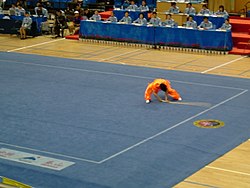
Modern forms are used in the sport of wushu, as seen in this staff routine
The word wu ( 武 ; wǔ ) means "martial". Its Chinese character is made of two parts; the showtime pregnant "walk" or "terminate" ( 止 ; zhǐ ) and the 2d meaning "lance" ( 戈 ; gē ). This implies that "wu 武" is a defensive use of gainsay.[ dubious ] The term "wushu 武術" meaning "martial arts" goes back as far as the Liang Dynasty (502–557) in an anthology compiled by Xiao Tong ( 蕭通 ), (Prince Zhaoming; 昭明太子 d. 531), called Selected Literature ( 文選 ; Wénxuǎn ). The term is found in the second verse of a poem by Yan Yanzhi titled: 皇太子釋奠會作詩 "Huang Taizi Shidian Hui Zuoshi".
"The great man grows the many myriad things . . .
Breaking away from the military arts,
He promotes fully the cultural mandates."
- (Translation from: Echoes of the Past past Yan Yanzhi (384–456))
The term wushu is also constitute in a verse form by Cheng Shao (1626–1644) from the Ming Dynasty.
The earliest term for 'martial arts' tin can be constitute in the Han History (206BC-23AD) was "military fighting techniques" ( 兵技巧 ; bīng jìqiǎo ). During the Vocal period (c.960) the name changed to "martial arts" ( 武藝 ; wǔyì ). In 1928 the proper noun was changed to "national arts" ( 國術 ; guóshù ) when the National Martial Arts Academy was established in Nanjing. The term reverted to wǔshù nether the People's Republic of China during the early on 1950s.
As forms have grown in complexity and quantity over the years, and many forms lonely could exist practiced for a lifetime, modern styles of Chinese martial arts have developed that concentrate solely on forms, and practise non practice awarding at all. These styles are primarily aimed at exhibition and competition, and frequently include more than acrobatic jumps and movements added for enhanced visual issue[62] compared to the traditional styles. Those who generally adopt to practice traditional styles, focused less on exhibition, are ofttimes referred to as traditionalists. Some traditionalists consider the competition forms of today'southward Chinese martial arts equally as well commercialized and losing much of their original values.[63] [64]
"Martial morality" [edit]
Traditional Chinese schools of martial arts, such equally the famed Shaolin monks, often dealt with the study of martial arts not only every bit a means of cocky-defense or mental training, only as a arrangement of ethics.[39] [65] Wude ( 武 德 ) can exist translated as "martial morality" and is synthetic from the words wu ( 武 ), which means martial, and de ( 德 ), which means morality. Wude deals with two aspects; "Virtue of act" and "Virtue of mind". Virtue of deed concerns social relations; morality of listen is meant to cultivate the inner harmony between the emotional mind ( 心 ; Xin ) and the wisdom mind ( 慧 ; Hui ). The ultimate goal is reaching "no extremity" ( 無 極 ; Wuji ) – closely related to the Taoist concept of wu wei – where both wisdom and emotions are in harmony with each other.
Virtues:
| Concept | Name | Traditional Chinese | Simplified Chinese | Pinyin romanization | Yale Cantonese Romanization |
|---|---|---|---|---|---|
| Humility | Qian | 謙 | 谦 | qiān | hīm |
| Virtue | Cheng | 誠 | 诚 | chéng | sìhng |
| Respect | Li | 禮 | 礼 | lǐ | láih |
| Morality | Yi | 義 | 义 | yì | yih |
| Trust | Xin | 信 | xìn | seun | |
| Concept | Name | Chinese | Pinyin romanization | Yale Cantonese Romanization |
|---|---|---|---|---|
| Courage | Yong | 勇 | yǒng | yúhng |
| Patience | Ren | 忍 | rěn | yán |
| Endurance | Heng | 恆 | héng | hàhng |
| Perseverance | Yi | 毅 | yì | ngaih |
| Will | Zhi | 志 | zhì | ji |
Notable practitioners [edit]
Examples of well-known practitioners ( 武術名師 ) throughout history:
- Yue Fei (1103–1142 CE) was a famous Chinese general and patriot of the Vocal Dynasty. Styles such every bit Eagle Claw and Xingyiquan attribute their cosmos to Yue. However, there is no historical evidence to support the claim he created these styles.
- Ng Mui (belatedly 17th century) was the legendary female founder of many Southern martial arts such as Fly Chun, and Fujian White Crane. She is often considered one of the legendary V Elders who survived the destruction of the Shaolin Temple during the Qing Dynasty.
- Yang Luchan (1799–1872) was an important teacher of the internal martial art known every bit t'ai chi ch'uan in Beijing during the 2nd half of the 19th century. Yang is known as the founder of Yang-style t'ai chi ch'uan, as well every bit transmitting the fine art to the Wu/Hao, Wu and Sun t'ai chi families.
- Ten Tigers of Canton (belatedly 19th century) was a group of ten of the summit Chinese martial arts masters in Guangdong (Canton) towards the stop of the Qing Dynasty (1644–1912). Wong Kei-Ying, Wong Fei Hung's father, was a member of this grouping.
- Wong Fei Hung (1847–1924) was considered a Chinese folk hero during the Republican menstruation. More than 1 hundred Hong Kong movies were made about his life. Sammo Hung, Jackie Chan, and Jet Li have all portrayed his character in blockbuster pictures.
- Huo Yuanjia (1867–1910) was the founder of Chin Woo Able-bodied Association who was known for his highly publicized matches with foreigners. His biography was recently portrayed in the motion-picture show Fearless (2006).
- Ip Human (1893–1972) was a master of the Wing Chun and the first to teach this style openly. Yip Homo was the teacher of Bruce Lee. Near major branches of Wing Chun taught in the Due west today were adult and promoted by students of Yip Man.
- Gu Ruzhang (1894–1952) was a Chinese martial creative person who disseminated the Bak Siu Lum (Northern Shaolin) martial arts system across southern China in the early 20th century. Gu was known for his expertise in Atomic number 26 Palm hand conditioning among other Chinese martial art grooming exercises.
- Bruce Lee (1940–1973) was a Chinese-American martial creative person and thespian who was considered an important icon in the 20th century.[66] He practiced Wing Chun and made it famous. Using Wing Chun as his base of operations and learning from the influences of other martial arts his experience exposed him to, he later on developed his own martial arts philosophy that evolved into what is at present called Jeet Kune Do.
- Jackie Chan (b. 1954) is the famous Hong Kong martial artist, movie actor, stuntman, action choreographer, director and producer, and a global pop culture icon, widely known for injecting physical comedy into his martial arts performances, and for performing complex stunts in many of his films.
- Jet Li (b. 1963) is the five-time sport wushu champion of China, later demonstrating his skills in cinema.
- Donnie Yen (b. 1963) is a Hong Kong player, martial creative person, flick director and producer, action choreographer, and globe wushu tournament medalist.
- Wu Jing (b. 1974) is a Chinese histrion, manager, and martial artist. He was a member of the Beijing wushu team. He started his career equally action choreographer and afterwards as an histrion.
In popular civilization [edit]
References to the concepts and use of Chinese martial arts tin be found in popular civilization. Historically, the influence of Chinese martial arts can be found in books and in the operation arts specific to Asia.[67] Recently, those influences have extended to the movies and television that targets a much wider audience. As a result, Chinese martial arts have spread across its ethnic roots and have a global appeal.[68] [69]
Martial arts play a prominent role in the literature genre known as wuxia ( 武俠小說 ). This blazon of fiction is based on Chinese concepts of chivalry, a separate martial arts order ( 武林 ; Wulin ) and a cardinal theme involving martial arts.[70] Wuxia stories tin can be traced as far back as 2nd and 3rd century BCE, condign popular by the Tang Dynasty and evolving into novel form by the Ming Dynasty. This genre is however extremely pop in much of Asia[71] and provides a major influence for the public perception of the martial arts.
Martial arts influences tin also exist found in trip the light fantastic, theater [72] and especially Chinese opera, of which Beijing opera is one of the best-known examples. This popular form of drama dates back to the Tang Dynasty and continues to exist an case of Chinese civilization. Some martial arts movements tin can be found in Chinese opera and some martial artists tin exist found as performers in Chinese operas.[73]
In mod times, Chinese martial arts take spawned the genre of movie house known every bit the Kung fu picture. The films of Bruce Lee were instrumental in the initial burst of Chinese martial arts' popularity in the W in the 1970s.[74] Bruce Lee was the iconic international superstar that popularized Chinese martial arts in the West with his ain variation of Chinese martial arts called Jeet Kune Do. It is a hybrid fashion of martial art that Bruce Lee proficient and mastered. Jeet Kune Do is his very own unique style of martial fine art that uses little to minimum movement just maximizes the issue to his opponents. The influence of Chinese martial art have been widely recognized and have a global appeal in Western cinemas starting off with Bruce Lee.
Martial artists and actors such equally Jet Li and Jackie Chan accept connected the appeal of movies of this genre. Jackie Chan successfully brought in a sense of humour in his fighting manner in his movies. Martial arts films from China are often referred to as "kung fu movies" ( 功夫片 ), or "wire-fu" if extensive wire piece of work is performed for special effects, and are all the same best known as part of the tradition of kung fu theater. (see as well: wuxia, Hong Kong activity picture palace). The talent of these individuals have broadened Hong Kong's cinematography production and rose to popularity overseas, influencing Western cinemas.
In the west, kung fu has get a regular activeness staple, and makes appearances in many films that would not by and large be considered "Martial Arts" films. These films include but are not limited to The Matrix franchise, Impale Beak, and The Transporter.
Martial arts themes tin also be found on television set networks. A U.S. network TV western series of the early on 1970s called Kung Fu also served to popularize the Chinese martial arts on goggle box. With 60 episodes over a three-year span, it was ane of the start N American TV shows that tried to convey the philosophy and practice in Chinese martial arts.[75] [76] The utilise of Chinese martial arts techniques tin can at present be found in most Goggle box action serial, although the philosophy of Chinese martial arts is seldom portrayed in depth.
Influence on hip hop [edit]
In the 1970s, Bruce Lee was commencement to gain popularity in Hollywood for his martial arts movies. The fact that he was a non-white male person who portrayed self-reliance and righteous self-subject field resonated with black audiences and made him an important effigy in this community.[77] Around 1973, Kung Fu movies became a hitting in America across all backgrounds; still, blackness audiences maintained the films' popularity well after the full general public lost interest. Urban youth in New York City were even so going from every borough to Time Square every night to watch the latest movies.[78] Among these individuals were those coming from the Bronx where, during this fourth dimension, hip-hop was commencement to take form. One of the pioneers responsible for the development of the foundational aspects of hip-hop was DJ Kool Herc, who began creating this new form of music by taking rhythmic breakdowns of songs and looping them. From the new music came a new form of dance known equally b-boying or breakdancing, a way of street dance consisting of improvised acrobatic moves. The pioneers of this dance credit kung fu as one of its influences. Moves such as the crouching depression leg sweep and "up rocking" (standing combat moves) are influenced by choreographed kung-fu fights.[79] The dancers' power to improvise these moves led way to battles, which were dance competitions between two dancers or crews judged on their inventiveness, skills, and musicality. In a documentary, Crazy Legs, a member of breakdancing group Rock Steady Crew, described the breakdancing battle beingness like an old kung fu pic, "where the i kung fu master says something along the lines of 'hun your kung fu is good, but mine is better,' then a fight erupts." [79]
Hip hop group Wu Tang Clan were prominently influenced by kung fu cinema. The name "Wu Tang" itself is a reference to the 1983 film Shaolin and Wu Tang. Subsequent albums by the group (especially their debut album Enter the Wu-Tang (36 Chambers)) are rich with references to kung fu films of the 1970s and 1980s, which group members grew upward watching. Several grouping members (Ghostface Killah, Ol' Dirty Bastard, Method Man, and Masta Killa) had also taken their stage names from kung fu cinema. Several music videos, promotional photos, etc. feature group members posing or engaging with kung fu regalia and action sequences.
Run into besides [edit]
- Xviii Arms of Wushu
- Hard and soft (martial arts)
- Kung fu (disambiguation)
- List of Chinese martial arts
- Wushu (sport)
- Kwoon
- Weapons and armor in Chinese mythology
Notes [edit]
- ^ Pages 26–33[24]
- ^ Pages 118–119[56]
References [edit]
- ^ Jamieson, John; Tao, Lin; Shuhua, Zhao (2002). Kung Fu (I): An Elementary Chinese Text. The Chinese University Press. ISBN978-962-201-867-nine.
- ^ Price, Monroe (2008). Owning the Olympics: Narratives of the New Cathay. Chinese University of Michigan Press. p. 309. ISBN978-0-472-07032-9.
- ^ a b c d Fu, Zhongwen (2006) [1996]. Mastering Yang Fashion Taijiquan. Louis Swaine. Berkeley, California: Bluish Ophidian Books. ISBN1-58394-152-5.
- ^ Van de Ven, Hans J. (Oct 2000). Warfare in Chinese History. Brill Academic Publishers. p. 328. ISBN90-04-11774-1.
- ^ Graff, David Andrew; Robin Higham (March 2002). A Military History of China. Westview Press. pp. fifteen–16. ISBN0-8133-3990-1. Peers, C.J. (2006-06-27). Soldiers of the Dragon: Chinese Armies 1500 BC–1840 AD . Osprey Publishing. p. 130. ISBN1-84603-098-6.
- ^ Dark-green, Thomas A. (2001). Martial arts of the world: an encyclopedia . ABC-CLIO. pp. 26–39. ISBN978-ane-57607-150-2.
- ^ Bonnefoy, Yves (1993-05-15). Asian Mythologies. trans. Wendy Doniger. University Of Chicago Press. p. 246. ISBN0-226-06456-5.
- ^ Zhongyi, Tong; Cartmell, Tim (2005). The Method of Chinese Wrestling. Due north Atlantic Books. p. five. ISBN978-1-55643-609-iii.
- ^ "Journal of Asian Martial Arts Volume sixteen". Journal of Asian Martial Arts. Via Media Pub. Co., original from Indiana University: 27. 2007. ISSN 1057-8358.
- ^ trans. and ed. Zhang Jue (1994), pp. 367–370, cited after Henning (1999) p. 321 and note eight.
- ^ Classic of Rites. Chapter 6, Yuèlìng. Line 108.
- ^ Henning, Stanley E. (Autumn 1999). "Academia Encounters the Chinese Martial arts" (PDF). China Review International. half-dozen (2): 319–332. doi:ten.1353/cri.1999.0020. ISSN 1069-5834. Archived (PDF) from the original on 2012-ten-17. Retrieved 2020-07-20 .
- ^ Sports & Games in Ancient China (Red china Spotlight Series). Prc Books & Periodicals Inc. December 1986. ISBN0-8351-1534-8.
- ^ Lao, Cen (April 1997). "The Development of T'ai Chi Ch'uan". The International Magazine of T'ai Chi Ch'uan. Wayfarer Publications. 21 (2). ISSN 0730-1049.
- ^ Dingbo, Wu; Patrick D. Murphy (1994). Handbook of Chinese Popular Culture. Greenwood Press. p. 156. ISBN0-313-27808-3.
- ^ Padmore, Penelope (September 2004). "Druken Fist". Black Belt Magazine. Active Interest Media: 77.
- ^ Broughton, Jeffrey L. (1999), The Bodhidharma Anthology: The Earliest Records of Zen, Berkeley: University of California Press, ISBN 0-520-21972-4. p. viii.
- ^ Canzonieri, Salvatore (February–March 1998). "History of Chinese Martial arts: Jin Dynasty to the Catamenia of Disunity". Han Wei Wushu. 3 (9).
- ^ Christensen, Matthew B. (2016-11-15). A Geek in Mainland china: Discovering the Land of Alibaba, Bullet Trains and Dim Sum. Tuttle Publishing. p. 40. ISBN978-1462918362.
- ^ Shahar, Meir (2000). "Epigraphy, Buddhist Historiography, and Fighting Monks: The Case of The Shaolin Monastery". Asia Major. Tertiary Series. 13 (2): 15–36.
- ^ Shahar, Meir (December 2001). "Ming-Menstruum Testify of Shaolin Martial Do". Harvard Journal of Asiatic Studies. Harvard-Yenching Establish. 61 (two): 359–413. doi:ten.2307/3558572. ISSN 0073-0548. JSTOR 3558572. S2CID 91180380.
- ^ Kansuke, Yamamoto (1994). Heiho Okugisho: The Secret of High Strategy. W.M. Hawley. ISBN0-910704-92-9.
- ^ Kim, Sang H. (Jan 2001). Muyedobotongji: The Comprehensive Illustrated Manual of Martial Arts of Ancient Korea. Turtle Press. ISBN978-ane-880336-53-three.
- ^ a b c Kennedy, Brian; Elizabeth Guo (2005-11-xi). Chinese Martial Arts Training Manuals: A Historical Survey. North Atlantic Books. ISBNi-55643-557-half-dozen.
- ^ Morris, Andrew (2000). National Skills: Guoshu Martial arts and the Nanjing Land, 1928–1937. 2000 AAS Annual Coming together, March 9–12, 2000. San Diego, CA, USA. Archived from the original on 2011-04-04. Retrieved 2008-06-04 .
- ^ Brownell, Susan (1995-08-01). Preparation the Trunk for China: sports in the moral order of the people's republic. University of Chicago Press. ISBN0-226-07646-6.
- ^ Mangan, J. A.; Fan Hong (2002-09-29). Sport in Asian Guild: By and Present. UK: Routledge. p. 244. ISBN0-7146-5342-X.
- ^ Morris, Andrew (2004-09-xiii). Marrow of the Nation: A History of Sport and Physical Civilisation in Republican Communist china. University of California Press. ISBN0-520-24084-7.
- ^ Amos, Daniel Miles (1986) [1983]. Marginality and the Hero'due south Art: Martial artists in Hong Kong and Guangzhou (Canton). Academy of California at Los Angeles: University Microfilms International. p. 280. ASIN B00073D66A. Retrieved 2011-12-07 .
- ^ Kraus, Richard Curt (2004-04-28). The Party and the Arty in China: The New Politics of Civilization (Land and Guild in East Asia). Rowman & Littlefield Publishers, Inc. p. 29. ISBN0-7425-2720-4.
- ^ Bin, Wu; Li Xingdong; Yu Gongbao (1995-01-01). Essentials of Chinese Wushu. Beijing: Foreign Languages Press. ISBN7-119-01477-3.
- ^ Riordan, Jim (1999-09-14). Sport and Concrete Educational activity in China. Spon Press (UK). ISBN0-419-24750-v. p.xv
- ^ Minutes of the eighth IWUF Congress Archived 2007-06-14 at the Wayback Machine, International Wushu Federation, December 9, 2005 (accessed 01/2007)
- ^ Zhang, Wei; Tan Xiujun (1994). "Wushu". Handbook of Chinese Popular Culture. Greenwood Publishing Group. pp. 155–168. 9780313278082.
- ^ Yan, Xing (1995-06-01). Liu Yamin, Xing Yan (ed.). Treasure of the Chinese Nation—The Best of Chinese Wushu Shaolin Kung fu (Chinese ed.). China Books & Periodicals. ISBNseven-80024-196-3.
- ^ Tianji, Li; Du Xilian (1995-01-01). A Guide to Chinese Martial Arts. Strange Languages Press. ISBN7-119-01393-9.
- ^ Liang, Shou-Yu; Wen-Ching Wu (2006-04-01). Kung Fu Elements. The Way of the Dragon Publishing. ISBN1-889659-32-0.
- ^ Schmieg, Anthony L. (December 2004). Watching Your Back: Chinese Martial Arts and Traditional Medicine. University of Hawaii Printing. ISBN0-8248-2823-ii.
- ^ a b Hsu, Adam (1998-04-15). The Sword Polisher's Record: The Way of Kung-Fu (1st ed.). Tuttle Publishing. ISBN0-8048-3138-6.
- ^ Wong, Kiew Kit (2002-11-fifteen). The Art of Shaolin Kung Fu: The Secrets of Kung Fu for Self-Defense force, Wellness, and Enlightenment. Tuttle Publishing. ISBN0-8048-3439-3.
- ^ Kit, Wong Kiew (2002-05-01). The Consummate Book of Shaolin: Comprehensive Program for Physical, Emotional, Mental and Spiritual Evolution. Cosmos Publishing. ISBN983-40879-1-8.
- ^ Zhongguo da bai ke quan shu zong bian ji wei yuan hui "Zong suo yin" bian ji wei yuan hui, Zhongguo da bai ke quan shu chu ban she bian ji bu bian (1994). Zhongguo da bai ke quan shu (中国大百科全书总编辑委員会) [Baike zhishi (中国大百科, Chinese Encyclopedia)] (in Chinese). Shanghai:Xin hua shu dian jing xiao. p. 30. ISBN7-5000-0441-ix.
- ^ Marker, Bow-Sim (1981). Wushu basic training (The Chinese Wushu Research Plant book serial). Chinese Wushu Research Found. ASIN B00070I1FE.
- ^ Wu, Raymond (2007-03-20). Fundamentals of High Performance Wushu: Taolu Jumps and Spins. Lulu.com. ISBN978-1-4303-1820-0.
- ^ Jwing-Ming, Yang (1998-06-25). Qigong for Wellness & Martial Arts, Second Edition: Exercises and Meditation (Qigong, Health and Healing) (2 ed.). YMAA Publication Centre. ISBNi-886969-57-4.
- ^ Raposa, Michael Fifty. (November 2003). Meditation & the Martial Arts (Studies in Rel & Culture). University of Virginia Press. ISBN0-8139-2238-0.
- ^ Ernst, Edzard; Simon Singh (2009). Trick or treatment: The undeniable facts about alternative medicine. W. W. Norton & Company. ISBN978-0393337785.
- ^ Cohen, Kenneth S. (1997). The Way Of Qigong: The Art And Science Of Chinese Energy Healing. Ballantine. ISBN0-345-42109-4.
- ^ Montaigue, Erle; Wally Simpson (March 1997). The Chief Meridians (Encyclopedia Of Dim-Mak). Paladin Press. ISBNane-58160-537-4.
- ^ Yang, Jwing-Ming (1999-06-25). Aboriginal Chinese Weapons, 2nd Edition: The Martial Arts Guide. YMAA Publication Center. ISBN1-886969-67-1.
- ^ Wang, Ju-Rong; Wen-Ching Wu (2006-06-13). Sword Imperatives—Mastering the Kung Fu and Tai Chi Sword. The Way of the Dragon Publishing. ISBNi-889659-25-eight.
- ^ Lo, Man Kam (2001-11-01). Police Kung Fu: The Personal Combat Handbook of the Taiwan National Law. Tuttle Publishing. ISBN0-8048-3271-four.
- ^ Shengli, Lu (2006-02-09). Combat Techniques of Taiji, Xingyi, and Bagua: Principles and Practices of Internal Martial Arts. trans. Zhang Yun. Blue Snake Books. ISBN1-58394-145-2.
- ^ Hui, Mizhou (July 1996). San Shou Kung Fu Of The Chinese Red Army: Practical Skills And Theory Of Unarmed Combat. Paladin Printing. ISBN0-87364-884-half-dozen.
- ^ Liang, Shou-Yu; Tai D. Ngo (1997-04-25). Chinese Fast Wrestling for Fighting: The Fine art of San Shou Kuai Jiao Throws, Takedowns, & Basis-Fighting. YMAA Publication Center. ISBNi-886969-49-iii.
- ^ a b Bolelli, Daniele (2003-02-20). On the Warrior's Path: Philosophy, Fighting, and Martial Arts Mythology. Frog Books. ISBNane-58394-066-9.
- ^ Kane, Lawrence A. (2005). The Way of Kata. YMAA Publication Center. p. 56. ISBN1-59439-058-4.
- ^ Johnson, Ian; Sue Feng (Baronial twenty, 2008). "Inner Peace? Olympic Sport? A Fight Brews". Wall Street Periodical. Retrieved 2008-08-22 .
- ^ Fowler, Geoffrey; Juliet Ye (Dec 14, 2007). "Kung Fu Monks Don't Become a Kick Out of Fighting". Wall Street Journal. Retrieved 2008-08-22 .
- ^ Seabrook, Jamie A. (2003). Martial Arts Revealed. iUniverse. p. 20. ISBN0-595-28247-4.
- ^ Verstappe, Stefan (2014-09-04). "Three hidden meanings of Chinese forms". Archived from the original on 2014-09-04. Retrieved 2019-04-12 .
- ^ Shoude, Xie (1999). International Wushu Competition Routines. Hai Feng Publishing Co., Ltd. ISBN962-238-153-seven.
- ^ Parry, Richard Lloyd (Baronial xvi, 2008). "Kung fu warriors fight for martial art'south time to come". London: Times Online. Retrieved 2008-08-22 .
- ^ Polly, Matthew (2007). American Shaolin: Flying Kicks, Buddhist Monks, and the Fable of Iron Crotch : an Odyssey in the New Cathay . Gotham. ISBN978-1-59240-262-five.
- ^ Deng, Ming-dao (1990-12-19). Scholar Warrior: An Introduction to the Tao in Everyday Life (1st ed.). HarperOne. ISBN0-06-250232-viii.
- ^ Joel Stein (1999-06-14). "ТІМЕ 100: Bruce Lee". Time. Archived from the original on January 14, 2008. Retrieved 2008-06-09 .
- ^ Mroz, Daniel (2012). The Dancing Word: An Embodied Approach to the Preparation of Performers and the Composition of Performances. Rodopi. ISBN978-9401200264.
- ^ Prashad, Vijay (2002-11-eighteen). Everybody Was Kung Fu Fighting: Afro-Asian Connections and the Myth of Cultural Purity. Beacon Press. ISBN0-8070-5011-three.
- ^ Kato, G. T. (2007-02-08). From Kung Fu to Hip Hop: Globalization, Revolution, and Popular Culture (Suny Serial, Explorations in Postcolonial Studies). State University of New York Press. ISBN978-0-7914-6992-7.
- ^ Denton, Kirk A.; Bruce Fulton; Sharalyn Orbaugh (2003-08-xv). "Affiliate 87. Martial-Arts Fiction and Jin Yong". In Joshua S. Mostow (ed.). The Columbia Companion to Modern East Asian Literature. Columbia University Printing. pp. 509. ISBN0-231-11314-5.
- ^ Cao, Zhenwen (1994). "Chapter 13. Chinese Gallant Fiction". In Dingbo Wu, Patrick D. Spud (ed.). Handbook of Chinese Pop Culture. Greenwood Publishing Group. p. 237. ISBN0313278083.
- ^ Mroz, Daniel (July 2009). "From Motility to Action: Martial Arts in the Do of Devised Concrete Theatre". Practice of Devised Concrete Theatre, Studies in Theatre and Functioning. 29 (2).
- ^ Mroz, Daniel (2011-04-29). The Dancing Word: An Embodied Approach to the Training of Performers and the Composition of Performances. (Consciousness, Literature & the Arts). Rodopi. ISBN978-9042033306.
- ^ Schneiderman, R. K. (2009-05-23). "Contender Shores Up Karate'south Reputation Among U.F.C. Fans". The New York Times . Retrieved 2010-01-thirty .
- ^ Pilato, Herbie J. (1993-05-xv). Kung Fu Book of Caine (1st ed.). Tuttle Publishing. ISBN0-8048-1826-6.
- ^ Carradine, David (1993-01-fifteen). Spirit of Shaolin . Tuttle Publishing. ISBN0-8048-1828-2.
- ^ Phil Hoad, "Why Bruce Lee and kung fu films hit domicile with blackness audiences", The Guardian
- ^ Wisdom B, "Know Your Hip-Hop History: The B-Boy", Throwback Magazine
- ^ a b Chris Friedman, "Kung Fu Influences Aspects of Hip Hop Culture Like Suspension Dancing"
Source: https://en.wikipedia.org/wiki/Chinese_martial_arts

Post a Comment for "Art That Represents Chinese Culture During Second Sino War"